Posts

Event 4

Image
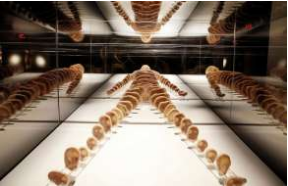
For my final event of the quarter, I attended Judith Hopf’s exhibit at the Hammer Museum.  Throughout the exhibit are several brick sculptures, some of which are pictured below.  Hopf’s biography indicates that she often builds her sculptures out of supplies found at a hardware store, thus explaining the brick.  The concept of square bricks being used within the sculptures allows for them to have this inherent look of technical perfection.  While the brick feet and hand were impressive sculptures that must have taken significant amount of time to build, my favorite was the penguin sculpture in the center of the room.  I think a large part of my appeal to it had to do with the way the square bricks still seem to resonate with this idea of technical perfection within the cylindrical frame of the sculpture.  The even levels and lines remind me of the way artists during the Renaissance began to integrate math, specifically geometry, with art. The exhib...

Week 9: Space + Art

Image
Our final topic of this quarter of space is very current and will continue to be a major focus of science and the arts for centuries to come.  My favorite topics covered in the lectures involved the first satellites and humans being sent into space. In 1957, right smack dab in the middle of the Cold War, the Soviets launched Sputnik I, the world’s first artificial satellite (NASA.gov).  While the U.S. at the time had been focusing on staying ahead of the arms race with the Soviets, the Russians chose to lap the Americans in the space race.  The size of a beach ball, Sputnik I was designed to be elegant and received massive media coverage of its launch, thanks to its ability to transmit radio signals back to Earth (History.com). Sputnik I Shortly thereafter, in 1961, the Russians secured another victory in the space race when they sent the first man into space, Yuri Gagarin (Redd).  The United States, would respond, however, with a massive push in space...

Week 8: Nanotechnology + Art

Image
Newman's Microscopic Text This week’s lectures and readings focused on the history of nanotechnology and its recently increasing applications.  One of the more fascinating things that I thought we covered in the lectures was the two competitions offered by Richard Feynman for the advancement of nanotechnology in 1959.  The first was to build a miniature motor that could fit inside of a 1/64 inch cube and the second was to reduce the size of a page of a book to a 1/25,000 linear scale (CalTech.edu).  The first cash prize of $1,000 was awarded relatively quickly to William McLellan in 1960, while the second prize took 25 years until Tom Newman completed the task using an electron beam in 1985 (Kornei).  Such advancements in nanotechnology have obvious application in the artistic and literary world, with new art being created out of nanostructures. I also found the invention of the scanning tunneling microscope in the 1980s to be particularly interesting within...

Event 3

Image
Film and Textile This past week, I attended Jeanine Oleson’s “Production of Copper” exhibit at the Hammer Museum.  The exhibit consisted of four parts: a video where four characters explore caves and mines, a TV screen showing the production of copper, a large floor textile, and a clay speaker.  All four of these items are connected by copper wires; however, only the wires between the TV screen and the clay speaker were visible.  The wire was not your typical electrical wire, but much thicker, with around 1/4” diameter.  It was interesting to see the wire actually come directly out of the TV screen, not the back side, with the remainder of the screen working as it normally would. Unfortunately, I showed up to the longer film that was being shown on the projector with about 5-10 minutes left, so I was unable to comprehend fully what was going on.   I was able to ask some questions about it to a Hammer employee, however, she told me that she had seen the ...

Week 7: Neuroscience + Art

Image
This week’s topic focused on neuroscience and the brain, an obvious connection with art as all creativity stems from the mind.  In the same way it was covered in my previous post on medicine and art, early art with respect to the mind focused on the anatomy of the brain.  Stemming off from anatomy has been the study of neural pathways through the usage of fluorescent proteins in the Brainbow process (Cai et. al).  These fluorescent proteins allow scientists to track “axons and dendrites over long distances”, allowing for much greater understanding of the intricate anatomy of the brains of several species (Harvard.edu).   Brainbow of Transgenic Mice Also connecting neuroscience with art are many drugs that invoke “trips” that cause the user to hallucinate in various forms.  One example of such a drug is LSD, which was invented by Albert Hofmann in 1938 (Smith).  While creating the compound, Hofmann accidentally ingested it, recalling later that he...

Event 2

Image
Last week I was able to attend the keynote address for the Chemical Entanglements: Gender and Exposure Conference.  The keynote speaker was Florence Williams, a writer and editor of various newspapers, and her presentation focused on the topic “The Burden of Breasts: Gender, Chemical Exposures, and Changing Bodies”. While there were some artistic elements to her address, it largely centered on the chemical effects (which lead to medical issues) that many everyday products have on the human body, specifically women’s breasts.  After hearing of studies into the alarmingly high amounts of PBDEs, compounds found in flame retardants, found in breast feeding moms in Europe, Ms. Williams decided to send in her own breast milk sample to a European lab to see how her levels compared to those of European moms.  What she, and other Americans found out, was that levels of PBDE found in the breast milk of breastfeeding American moms was ten times higher than that of the average...

Week 6: BioTech + Art

Image
This week’s topic, biotechnology and art, involves more recent and controversial art, as living organisms are used as an artistic medium.  I found one of the more fascinating works of art discussed this week to be that of Stelarc, the man with a “third ear” implanted into his arm.  While the implanted ear was made of material commonly used in plastic surgery, his own tissue has morphed with the ear so that it is now a fully living part of his body (McCafferty).  In the future, Stelarc wishes to have a small microphone inserted into his “third ear” so that the entire world can listen in, with this worldwide connection being the artistic value that Stelarc sees in his implanted “masterpiece” (DailyMail.co.uk). Stelarc's Third Ear The more controversial side of BioArt comes in the genetic modification of living species, such as Kathy High’s work with transgenic mice.  High was able to genetically modify certain mice by including foreign genetic material and w...

Midterm Project Link

https://drive.google.com/file/d/0B0rLribFznyQOUxiMmVIRlVrWGM/view?usp=sharing

Week 4: MedTech + Art

Image
The most obvious evidence of art in the medical world comes in the form of anatomy, where artists and medical professionals have worked rigorously on correctly identifying the internal structure and makeup within different species.  This overall structure includes muscles, bones, organs, and ligaments.  While doctors have performed the experiments required to correctly identify the overall structure of bodies, artists are required to actually realistically and accurately represent what doctors have proven from experiment.  One example of such artistic reconstruction can be seen at the Bodies Exhibit, which displays 13 whole body human specimens at the Luxor in Las Vegas (Luxor.com).   Bodies Exhibit The advent of computational technological advancement has allowed for further reconstruction and imaging of internal body structure.  Some examples of such imaging includes X-Rays, MRIs, and CAT scans.  I, personally, have undergone dozens of X-Rays a...

Event 1

Image
This past week I was fortunate enough to attend one of Linda Weintraub’s (seen below) Art/Sci Eco-centric Art workshops.  This workshop focused on our more primitive past and the usage of our senses with respect to objects found in nature.  Specifically, the objects that Linda had on display were all found on her walks through the woods surrounding her home in New York.  Prior to entering the workshop exhibit, Linda expressed to us how she wanted us to focus more innately on our keen senses of touch and smell, without talking. Her “Welcome to My Woods” exhibit had several different themes, including volume, mass and weight, scent, form and beauty, and touch (with one’s feet).  Each of the specific objects, or collections of objects, had specific instructions as a guide to how one may go about inspecting them in order to really grasp the natural state that these items came from.  The instructional guide for the branches and rhizomes can be seen to ...

Week 3: Robotics + Art

Image
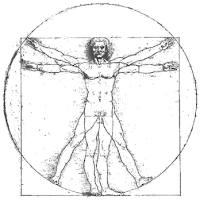
Since the dawn of industrialization, what we perceive as art has changed dramatically, thanks ultimately to mechanization.  The explosion of personal computers and Moore’s Law in the latter half of the 20 th century further drove mechanization and computation to set the stage for a new type of masterpiece: robotics (Intel.com). Vitruvian Man What was once reserved for sculptures and paintings, humanoids became a new focus of idealized beauty.  During the Renaissance, artists such as Leonardo da Vinci focused on this idealized, perfect human form, as seen in his Vitruvian Man; but recently, humanoid designers have taken up this focus on realistic human idealization (Stanford.edu).  Dr. Dennis Hong, Professor of Mechanical and Aerospace Engineering at UCLA, has succeeded in this blending of art and science into CHARLI, “the United States’ first full-size autonomous human robot” (Hong).  CHARLI is able to walk in any direction, as well as kick, and perform s...

Week 2: Math + Art

Image
In Edwin Abbott’s Flatland , Abbott describes that the shapes of an object that we optically perceive change with one’s perspective.  He specifically uses an example of a penny sitting upon a table to express how it could be seen as a line, circle, or oval, depending upon the viewer’s angle (Abbott 2).  While Abbott’s view is certainly correct, he is not the first to have conceived the idea of perspective, or linear perspective, in art.  Mathematics really began to influence the work of artists during the Renaissance, with artists intensely studying optics and light.  Brunelleschi, in particular, utilized basic geometry in the forms of triangles and rectangles, and embraced perspective (PBS.org).  Leonardo da Vinci further built upon Brunelleschi’s principles of perspective and geometry, as can be seen by the uses of vertices and a vanishing point in The Last Supper (LeonardoDaVinci.net, Frantz). The idea of math in art by utilizing linear perspe...