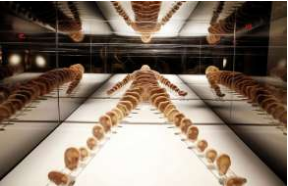
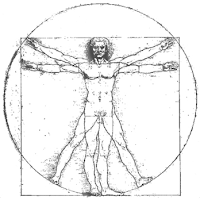
In Edwin Abbott’s Flatland , Abbott describes that the shapes of an object that we optically perceive change with one’s perspective. He specifically uses an example of a penny sitting upon a table to express how it could be seen as a line, circle, or oval, depending upon the viewer’s angle (Abbott 2). While Abbott’s view is certainly correct, he is not the first to have conceived the idea of perspective, or linear perspective, in art. Mathematics really began to influence the work of artists during the Renaissance, with artists intensely studying optics and light. Brunelleschi, in particular, utilized basic geometry in the forms of triangles and rectangles, and embraced perspective (PBS.org). Leonardo da Vinci further built upon Brunelleschi’s principles of perspective and geometry, as can be seen by the uses of vertices and a vanishing point in The Last Supper (LeonardoDaVinci.net, Frantz). The idea of math in art by utilizing linear perspe...